
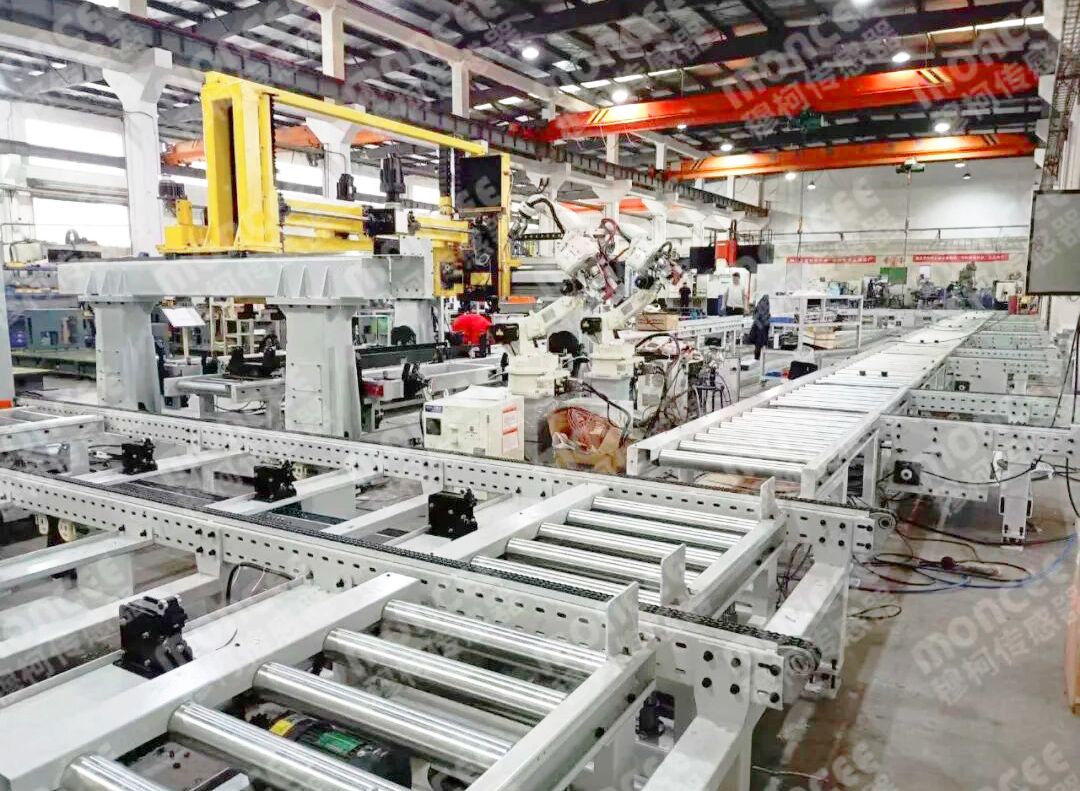
In robotic arm automation applications, safety is always the bottom line. At present, most factories still rely on three traditional protection solutions: safety fences, safety door interlocks, and safety light curtains. However, potential safety hazards continue to occur frequently on the shop floor. The fundamental problem is that traditional protection methods have blind spots, limited flexibility, frequent false stops, and can interfere with production.
Today, we introduce a complementary protection device: the safety mat, specifically designed to address safety challenges such as low-level blind spots around robotic arms, floor-level intrusion, and human-machine collaborative operations.
1. Why Traditional Protection Methods Are No Longer Enough
Many robotic arm accidents in workshops occur not because no safety protection has been installed, but because traditional protection methods have inherent limitations:
Safety Fences:
They provide purely physical isolation and offer limited flexibility. During commissioning, material loading/unloading, and maintenance, they often need to be repeatedly opened or removed, affecting productivity. Blind spots can also exist at the bottom and corners, making it difficult to detect personnel entering the area by bending down or stepping over the barrier.
Safety Door Interlocks:
They can only detect whether the safety door is open or closed. They are ineffective against climbing over the fence, entering through gaps, or bypassing the designated access route. This is essentially a passive protection method without predictive detection or comprehensive area monitoring.
Safety Light Curtains:
Although widely used, they also have obvious limitations. They primarily protect the vertical plane covered by the light beams, leaving the floor, feet, and low-level areas outside the detection range. Dust, oil contamination, or workpieces blocking the beams can also cause false triggering or missed detection, resulting in frequent machine stops that disrupt production.
In short: traditional solutions mainly address “visible protection areas” while overlooking the potentially dangerous risk of low-level intrusion from the floor.
2. What Is a Safety Mat?
Working Principle
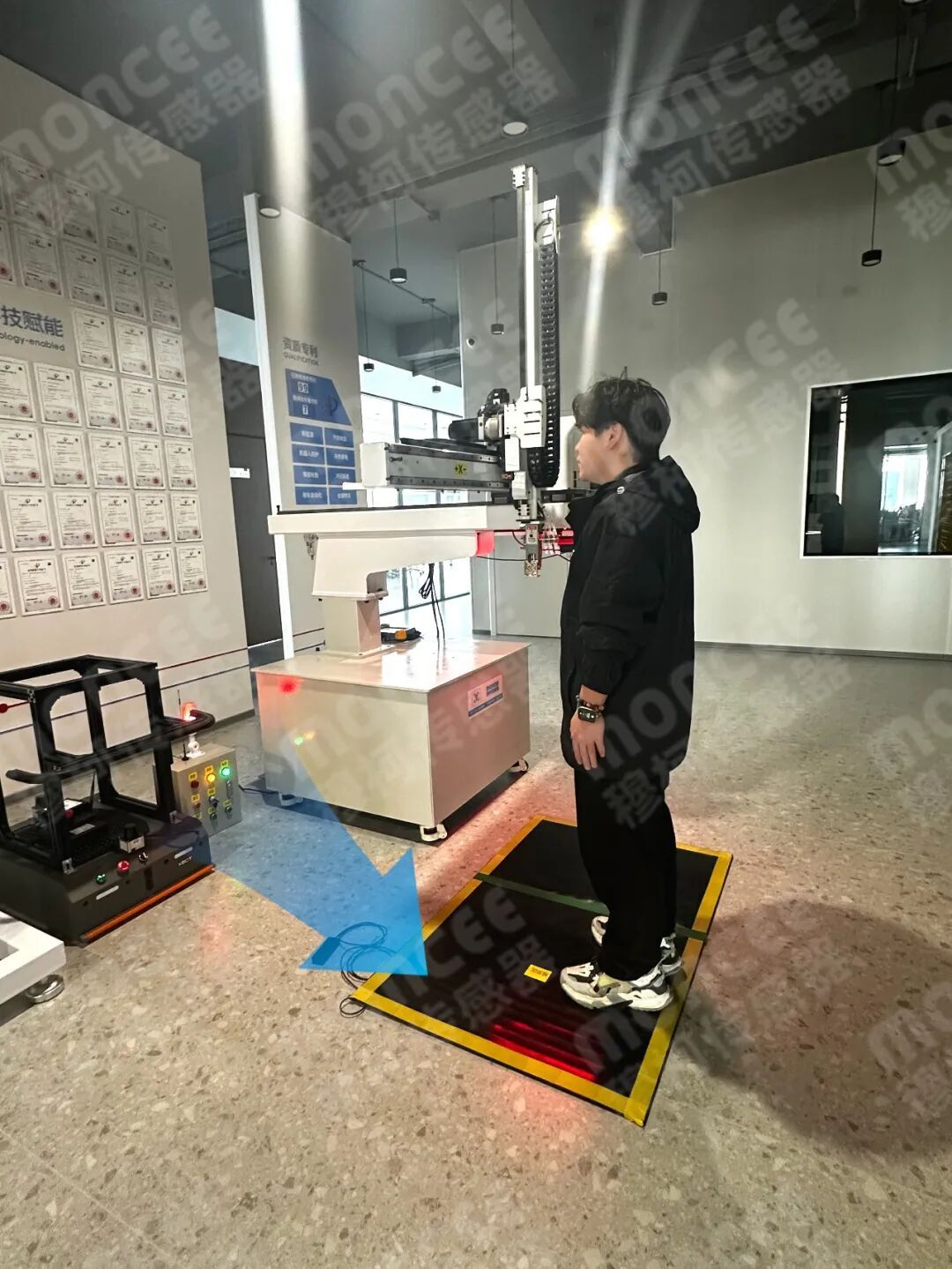
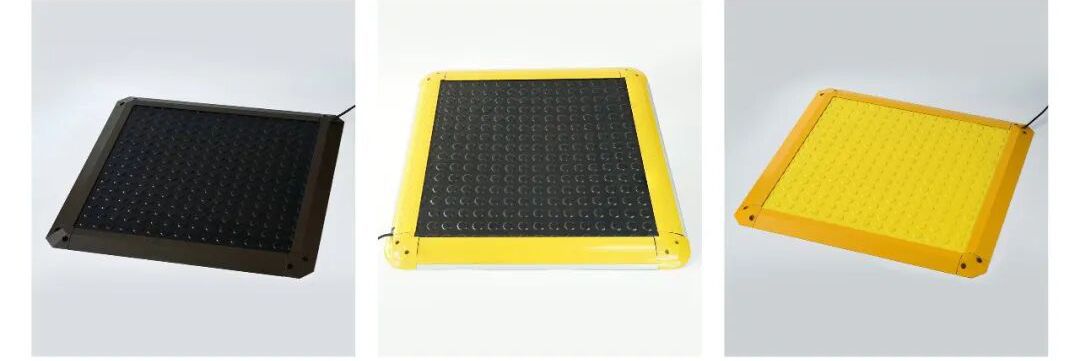
A safety mat is an industrial pressure-sensitive, flat safety protection device installed on the floor within the hazardous area of a robotic arm.
When no one is stepping on the mat, the system remains in standby mode and the robotic arm operates normally. When a person enters or remains in the hazardous area, the pressure applied to the mat immediately triggers a signal. Working together with the safety controller, the system can activate an alarm, emergency stop, or power shutdown, helping prevent crushing and collision accidents at the source.
Key Parameters
Trigger force:
30 kg human-presence detection helps filter out false triggers caused by debris or lightweight falling materials, balancing sensitivity and stability.
Response time:
≤30 ms rapid braking response, significantly faster than human reaction time and suitable for rapid robotic arm shutdown.
Protection rating:
IP65 protection against dust, water, and oil contamination, suitable for demanding applications such as welding, grinding, and material handling.
Safety level:
When used together with the appropriate safety controller, the system can achieve Safety Level 3 protection, with fault self-diagnosis to help prevent protection failures.
3. Safety Mat vs. Traditional Protection: Key Advantages
Safety mats do not replace safety light curtains or safety fences. Instead, they complement existing protection systems by eliminating low-level blind spots and creating three-dimensional + floor-level protection.
Floor-Level Area Protection
A safety mat can cover the floor area within the entire hazardous zone.
Regardless of which direction a person enters from, stepping onto the mat can trigger immediate detection. This effectively addresses the side-entry and low-level blind spots that can occur with planar protection solutions such as light curtains.
Minimal Impact on Production Efficiency
No enclosed space is required, and there is no need for frequent disassembly.
Personnel can normally pass through during commissioning, material loading/unloading, and inspection, making safety mats suitable for flexible production, human-machine collaboration, and frequently reconfigured production lines.
Strong Interference Resistance and Stable Operation
Safety mats are not affected by lighting conditions, dust, or workpieces blocking an optical beam.
Unlike light curtains, they are less prone to frequent false stops, helping maintain greater production continuity.
Flexible Installation and Reusability
Safety mats can be customized, interconnected, and repositioned to accommodate both fixed and mobile robotic arms.
They can also be reused during production-line modifications, helping reduce long-term protection costs.
4. Typical Applications
Robotic arm workstations for gripping, handling, welding, and grinding
Open workstations for human-machine collaborative operations
Low-level blind-spot protection around industrial equipment
Automated production lines requiring frequent line changes and flexible personnel access
Conclusion
Traditional safety fences, door interlocks, and light curtains remain the foundation of industrial safety protection. However, the blind spots left between these protection methods can become precisely where accidents occur most frequently.
By using pressure-sensitive floor detection, safety mats fill this final gap in the safety system. With lower modification costs, greater stability, and more flexible installation, they provide effective protection for robotic arm operating areas while achieving the right balance between safety and production efficiency.



 English
 简体中文
简体中文 Indonesian
 Previous:
 Back to list


