
When an industrial door moves automatically, the closing edge can become a potential point of crushing, trapping, or collision. A properly selected Safety Edge can help detect physical contact with an obstacle and trigger a safety response before the hazard causes further harm.
For manufacturers, installers, and system integrators, the more important question is often not simply “What is a Safety Edge?” but “Where can I buy reliable Safety Edge equipment for industrial doors, and how do I know which supplier is suitable?”
The answer depends on the door design, operating speed, installation environment, required sensing characteristics, and control architecture. Purchasing from a manufacturer that can provide different profiles, wiring configurations, lengths, and customization options can make the integration process significantly easier.
Why Do Industrial Doors Need a Safety Edge?
Industrial doors are frequently automated to improve production efficiency, access control, and logistics operations. However, their moving panels or closing edges can create dangerous pinch and crushing points.
A Safety Edge provides a contact-sensitive layer of protection. When an object or person presses the sensing edge, the internal sensing circuit detects a change in electrical resistance. The connected safety controller can then generate a signal to stop or reverse the door movement.
This makes Safety Edge particularly useful for:
Automatic industrial doors
Sliding doors
Motorized gates
Rolling doors and shutters
Material-handling access doors
Automated warehouse entrances
Production-line access doors
Machine doors and movable panels
For an industrial door manufacturer, the key benefit is that the sensor can follow the physical edge of the moving structure rather than requiring a large rigid safety device.
Where Can You Buy Safety Edge Equipment?
There are generally three purchasing routes for industrial Safety Edge equipment: directly from a manufacturer, through an industrial automation distributor, or through a system integrator.
1. Buy Directly from a Safety Sensor Manufacturer
For OEM projects and recurring industrial requirements, purchasing directly from a manufacturer is often the most practical option.
A direct manufacturer can typically provide technical information about the sensing profile, trigger characteristics, electrical configuration, cable arrangement, installation method, and customization options. This is particularly valuable when the Safety Edge must be integrated into a new industrial door design.
Direct purchasing can also simplify communication when you need:
Custom Safety Edge lengths
Special cable lengths
Different wiring configurations
Specific sensing profiles
Series-connected Safety Edges
Customized bending or installation structures
Technical support during integration
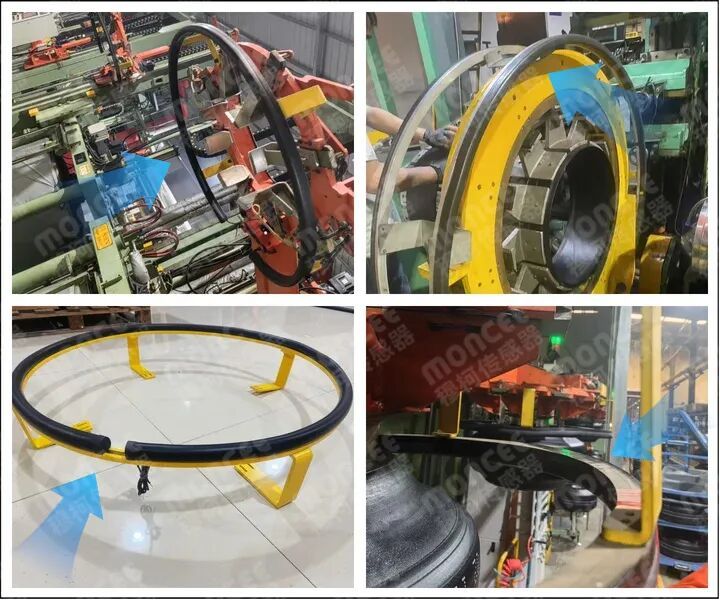
For example, the Moncee catalog provides multiple Safety Edge profiles and indicates customization options for product length, lead-wire length, wiring configuration, resistor configuration, and profile bending. A single Safety Edge can be produced to a length of approximately 8 meters, with series connection available according to system requirements.
2. Purchase Through an Industrial Automation Distributor
A distributor can be useful when you need local inventory, local technical support, or smaller quantities.
However, buyers should confirm whether the distributor is supplying the manufacturer's genuine product and whether technical support is available for the complete safety system.
Before placing an order, ask the distributor for the manufacturer's product documentation and confirm the exact model number, dimensions, trigger characteristics, electrical configuration, and compatible controller.
3. Purchase Through a System Integrator
A system integrator may be appropriate when the Safety Edge is only one component of a larger industrial door safety system.
For example, an integrator may handle the door motor, control system, safety controller, sensors, emergency-stop functions, and installation as a complete project.
This can reduce engineering workload, but it may also make it more difficult to compare the actual cost and specifications of the Safety Edge itself. For OEM manufacturers, purchasing directly from a sensor manufacturer can therefore provide greater control over product selection and customization.
What Should You Check Before Buying a Safety Edge?
Price should not be the first selection criterion. A Safety Edge is part of a machine safety system, so compatibility and performance are more important than simply purchasing the lowest-priced product.
1. Safety Edge Profile and Dimensions
Industrial doors have different structural designs. A compact door may require a small cross-section, while a large industrial door may need a larger sensing profile.
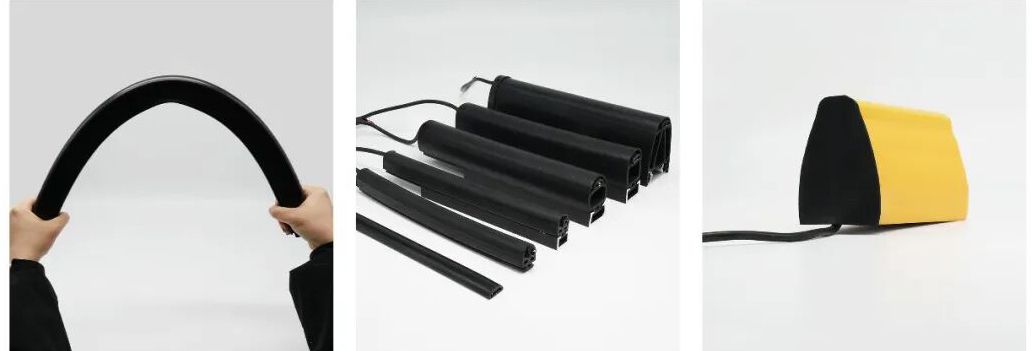
The Moncee product range includes multiple profile sizes, including compact profiles and larger configurations such as approximately 40 × 80 mm, 40 × 100 mm, and 54 × 56 mm.
The correct profile should fit securely onto the door structure while providing the required sensing area.
2. Trigger Distance
Trigger distance determines how much compression is required to activate the Safety Edge.
Available configurations in the product catalog include trigger distances such as 2–5 mm, 2–6 mm, 5–10 mm, and 7–13 mm.
For industrial doors, the correct value should be considered together with door speed, stopping distance, inertia, and the characteristics of the hazardous area.
3. Trigger Force
The force required to activate the Safety Edge is another important consideration.
Different products in the catalog have different trigger-force ranges, including approximately 5–15 N, 8–25 N, and 20–50 N, depending on the model.
A door that regularly operates around personnel may require different sensing characteristics from a heavy industrial door operating in a controlled logistics environment.
4. Electrical Configuration
Before purchasing, confirm whether the Safety Edge is compatible with the intended safety controller.
Important questions include:
Is the required configuration NO or NC?
What supply voltage is required?
What cable configuration is needed?
Is an end resistor required?
Can multiple Safety Edges be connected in series?
How will the Safety Edge integrate with the existing door controller?
The Moncee catalog provides multiple wiring configurations, including single-sided and double-sided wiring arrangements and different cable-exit designs.
Environmental Conditions Also Matter
Industrial doors may operate in warehouses, factories, logistics centers, outdoor loading areas, or environments with temperature fluctuations.
The Moncee product documentation specifies an EPDM outer material, an operating temperature range of approximately -30°C to +85°C, and IP65 protection for the relevant product series. Nominal voltage options include 12 V and 24 V, with maximum electrical values specified according to the product model.
These specifications should be compared against the actual operating environment before ordering.
For example, if an industrial door is exposed to dust, moisture, temperature changes, or frequent mechanical contact, the buyer should confirm that the selected Safety Edge is appropriate for those conditions.
Why Customization Can Be Important for Industrial Door OEMs
Standard products are not always sufficient for industrial door manufacturers.
A door may have a non-standard width, curved edge, unusual cable-routing requirement, or limited installation space. In such cases, a customized Safety Edge can reduce mechanical modification and simplify integration.
When requesting a quotation, provide the supplier with:
Door dimensions
Safety Edge installation position
Required sensing length
Cross-section or available mounting space
Door operating speed
Expected stopping distance
Required trigger force
Electrical voltage
Controller information
Cable direction and required cable length
Environmental conditions
Required quantity
The more complete this information is, the easier it is for the manufacturer to recommend a suitable configuration instead of simply quoting a generic Safety Edge.
A Practical Buying Checklist
Before placing an order, ask the supplier to confirm the following:
Requirement | What to Confirm |
Product type | Safety Edge suitable for industrial doors |
Profile | Dimensions and mounting method |
Trigger distance | Required activation range |
Trigger force | Force required for activation |
Material | EPDM or applicable material |
Protection | IP rating |
Temperature | Operating temperature range |
Voltage | 12 V / 24 V or required specification |
Wiring | NO/NC and cable configuration |
Length | Standard or customized length |
Controller | Compatible safety controller |
| Customization | Bending, cable, resistor and profile options |
| Application | Door type and hazard characteristics |
Why Consider a Direct Safety Edge Manufacturer?
For buyers purchasing Safety Edge equipment for industrial doors, the supplier's manufacturing capability can be just as important as the product itself.
A suitable supplier should be able to discuss the application with your engineering team, recommend an appropriate profile, explain trigger characteristics, confirm controller compatibility, and provide customized configurations when necessary.
This is especially important for industrial door OEMs, automation companies, warehouse-equipment manufacturers, and system integrators that may need the same Safety Edge configuration across multiple machines or projects.
Rather than treating Safety Edge as a standard electrical component, it is better to treat it as part of the overall machine safety design.
Request a Safety Edge Quote for Your Industrial Door
If you are currently sourcing Safety Edge equipment for industrial doors, the fastest way to identify the right configuration is to provide the supplier with your door dimensions, installation drawing or photos, required sensing length, operating environment, electrical requirements, and expected application conditions.
Moncee provides multiple Safety Edge profiles and configurations for industrial applications, with options for different dimensions, trigger characteristics, wiring arrangements, cable lengths, and customized structures.
For OEM and project-based applications, you can contact the manufacturer directly for model selection and a quotation rather than purchasing an unsuitable standard product first.
The right Safety Edge is not necessarily the cheapest one. It is the one that fits your industrial door, matches the safety-control architecture, meets the required sensing characteristics, and can be reliably integrated into your equipment.
If you are ready to source Safety Edge products, prepare your door specifications and application requirements and request a technical recommendation and quotation from the manufacturer. This approach can help reduce integration problems, avoid unnecessary redesign, and move your industrial door safety project from product selection to implementation more efficiently.



 English
 简体中文
简体中文 Indonesian
 Previous:
 Back to list


