
If you run or operate a sheet-metal fabrication workshop, you have probably experienced these problems firsthand:
New operators take too long to get up to speed, while experienced operators are always in short supply. Every time the production order changes, repeated test bends are required, resulting in piles of scrap. The machine keeps running, yet the first-pass yield remains low and production schedules are constantly delayed.
In reality, the difficulty of press brake bending is often not due to inadequate equipment. The problem is the lack of proper auxiliary tools, leaving operators to rely heavily on experience, visual judgment, and trial and error.
Today, we are introducing two essential tools for sheet-metal fabrication: the press brake laser alignment tool and the dedicated press brake angle gauge.
One handles positioning; the other controls bending angle. Together, they can address many of the most common problems encountered during sheet-metal bending.
Laser Alignment Tool: Forget the Tape Measure and Marker
In conventional press brake operations, one of the biggest sources of wasted time is marking, alignment, and calibration.
Manual marking introduces errors. Tape-measure readings can vary. Poor lighting and special sheet-metal surfaces can make alignment even more difficult. Even a small positioning error can result in a defective workpiece.
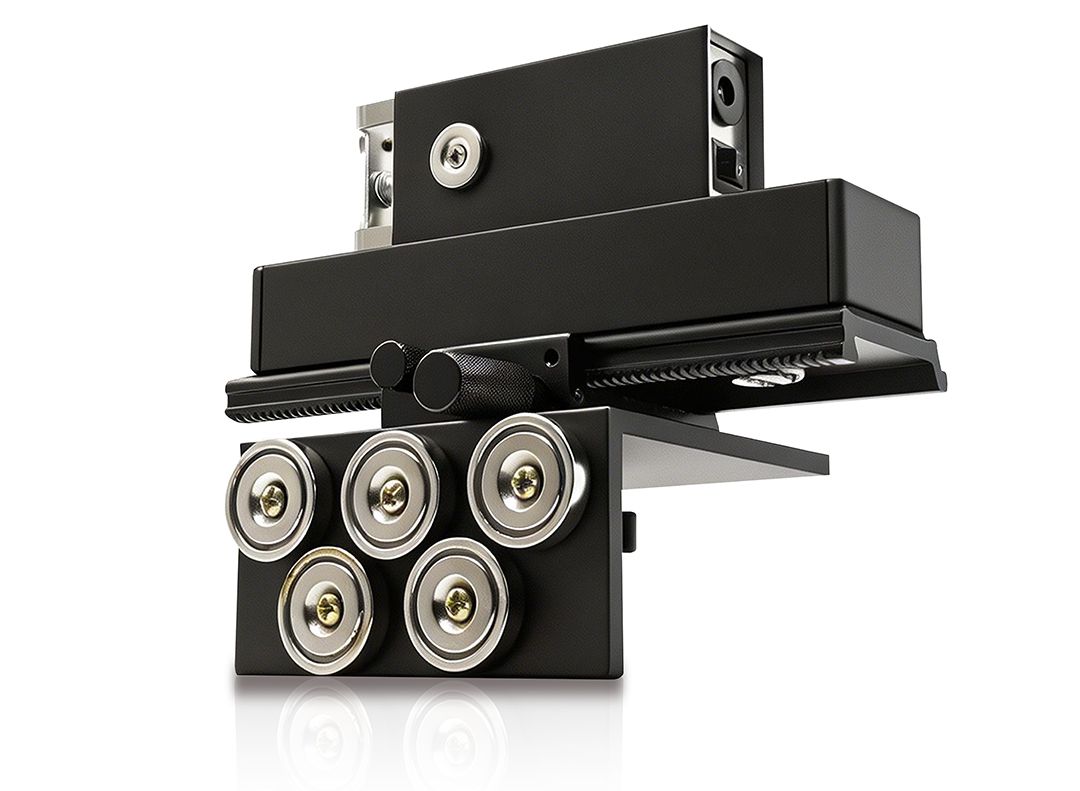
With a laser alignment tool, the bending reference line can be projected directly onto the workpiece.
Its high-visibility green laser line remains clearly visible even under strong workshop lighting, allowing operators to identify the bending reference line at a glance.
The powerful magnetic mounting system requires no drilling or machine modification. It can be used across a wide range of press brakes and shearing machines, with 360° adjustment to accommodate different bending applications and workpiece configurations.
No repeated measurements. No manual marking.
Simply align the sheet with the projected laser line and start bending.
New operators can quickly learn the positioning process, while experienced operators can work more efficiently. Changeovers become faster, and positioning consistency is significantly improved during batch production.
Press Brake Angle Gauge: Get the Correct Angle Without Repeated Test Bends
Even when the workpiece is correctly positioned, why does rework still occur so frequently?
The key issue is bending-angle variation caused by material springback, machine wear, and parameter fluctuations.
Estimating angles by eye or relying on basic angle rulers can lead to insufficient measurement accuracy. During batch production, inconsistent bending angles can result in assembly problems and even customer returns.
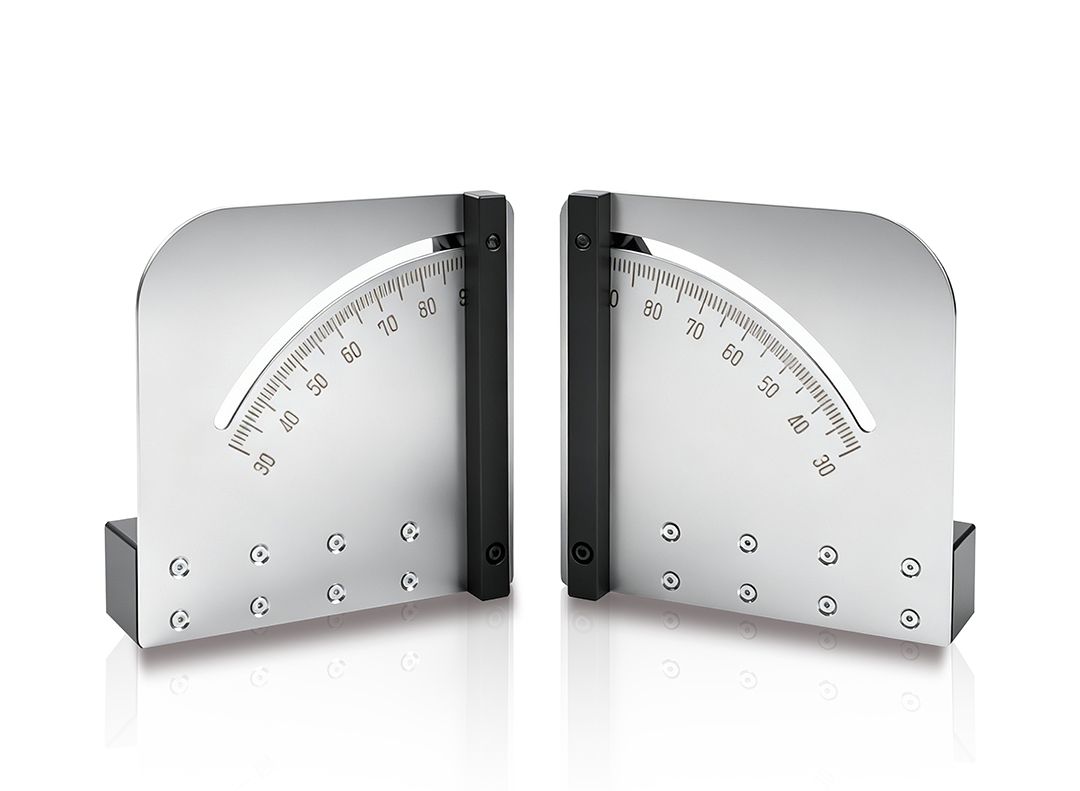
The MONCEE-JDY-01 Dedicated Press Brake Angle Gauge is designed specifically to address bending-angle measurement and consistency.
Its reinforced 304 stainless-steel body provides resistance to oil contamination and impact, making it suitable for demanding workshop environments.
A powerful magnetic mounting system securely attaches the gauge to the machine, while its mechanical locking mechanism helps prevent movement or displacement caused by bending vibration.
With high-precision measurement covering 20°–90°, it is suitable for conventional sheet-metal bending applications.
Once the desired angle is measured and the gauge is securely locked in position, operators can maintain consistent bending angles throughout a production batch.
This helps reduce angle variation caused by material springback and minimizes the need for repeated test bends.
The Perfect Combination: A Tool on Its Own Is Useful; Together, They Become a Complete Solution
A common mistake in sheet-metal workshops is relying on only one of these tools.
With only the laser alignment tool, positioning can be highly accurate, but bending-angle variation may still occur.
With only the angle gauge, the bending angle can be controlled, but inaccurate positioning may still lead to dimensional deviations.
The laser alignment tool ensures accurate positioning.
The angle gauge ensures consistent forming angles.
Used together, they provide dual control—from initial positioning and alignment through bending and final dimensional verification.
This integrated approach helps reduce dependence on highly experienced operators, minimize material waste, improve production efficiency, and maintain consistent quality across batches.
Conclusion
Two Compact Tools. Big Improvements for Your Sheet-Metal Workshop.
Reducing costs and improving production efficiency does not necessarily require replacing your existing equipment with expensive imported machinery.
A press brake laser alignment tool + dedicated angle gauge can provide a cost-effective way to address common bending challenges.
With better positioning accuracy and more consistent bending angles, these two compact tools can help improve first-pass yield, reduce material waste, shorten setup and changeover time, and increase overall production efficiency.
A practical, cost-effective upgrade for sheet-metal fabrication workshops looking to improve bending quality and productivity.



 English
 简体中文
简体中文 Indonesian
 Previous:
 Back to list


