
In industrial environments, protecting personnel around moving machinery requires more than physical barriers alone. Operators may need to enter production areas, load materials, inspect equipment, or work close to automated systems during normal production. In these situations, a Safety Pressure Mat can provide area-based presence detection and help initiate a machine safety response when a person enters a protected zone.
Unlike a conventional floor mat, an industrial Safety Pressure Mat is a pressure-sensitive safety device. When sufficient pressure is applied to its sensing surface, the mat generates an electrical switching signal. When connected to an appropriate safety controller and machine safety circuit, this signal can be used to initiate a stop or inhibit hazardous machine operation.
The Moncee SC4 series is designed for industrial and specialized applications including automated industrial equipment, robot work areas, printing equipment, forklifts, vehicle safety protection, and other environments where pressure-based area detection is required.
For OEM machine builders, automation integrators, distributors, and industrial procurement teams, the key question is therefore not simply whether to purchase a Safety Pressure Mat. It is how to select the right configuration, integrate it correctly, and source it efficiently for long-term use.
What Is a Safety Pressure Mat?
A Safety Pressure Mat is an area-sensitive safety device installed on the floor around machinery or hazardous equipment.
Its operating principle is straightforward: when a person steps onto the protected surface and applies sufficient pressure, the internal sensing structure changes its electrical state. The resulting signal can be transmitted to a safety controller, which evaluates the mat status and interfaces with the machine's safety circuit.
This makes a Safety Pressure Mat particularly useful where the hazardous area cannot be effectively protected by a simple point sensor.
For example, a machine may have an open operator access area around its working zone. Instead of monitoring only one entrance, a pressure mat can create a defined detection area on the floor. If personnel enter that area, the safety system can respond according to the machine's configured safety logic.
The Moncee documentation also provides connection configurations for individual mats and multiple mats, allowing larger areas to be protected through combined installations.
How Does a Safety Pressure Mat Stop a Machine?
One of the most important issues for buyers is understanding the difference between detection and machine stopping.
The Safety Pressure Mat itself primarily performs pressure detection. The complete machine-stop function normally depends on its connection with the safety controller and the machine's safety circuit.
A typical protection sequence can be understood as:
Personnel enters protected area → Safety Pressure Mat detects pressure → Switching signal is generated → Safety controller processes the signal → Machine safety circuit responds → Hazardous machine operation is stopped or inhibited.
This system architecture allows the pressure-sensitive mat to become part of a broader machine safety solution rather than functioning as an independent emergency device.
The product documentation includes dedicated wiring information and controller-related connection configurations, including multi-mat applications.
For OEM engineers, this means the mat should be selected together with the controller, machine control system, installation structure, and required safety function.
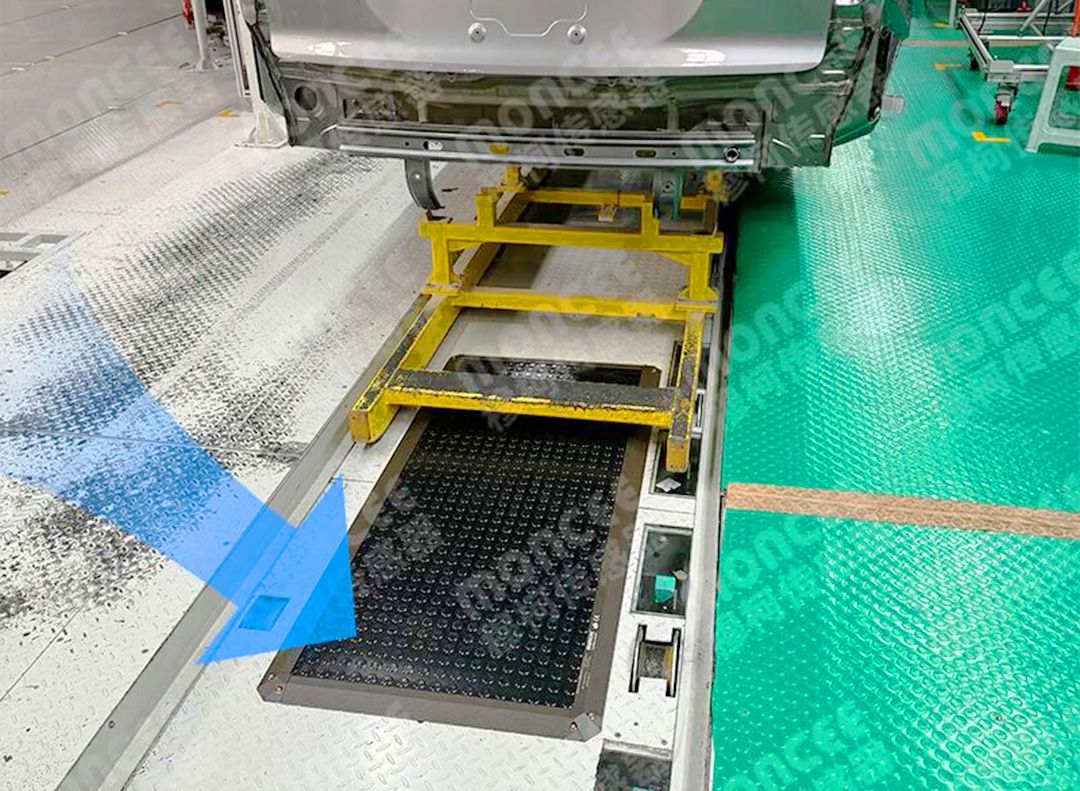
Industrial Applications of Safety Pressure Mats
A Safety Pressure Mat is particularly useful when personnel movement itself needs to be detected.
1. Automated Machinery
Automated production equipment may contain moving mechanisms, processing components, or other hazardous areas that operators need to approach during production or maintenance.
A pressure-sensitive floor area can help monitor access around the machine while maintaining a relatively open working layout.
The SC4 series documentation identifies automated industrial equipment as one of its application areas.
2. Robot Work Areas
Industrial robots can create large hazardous zones because their movement range may extend beyond a single access point.
A Safety Pressure Mat can be positioned around a robot working area to detect personnel entering the protected zone.
This approach can be especially useful when operators and robots must work within the same production environment and the machine layout makes conventional fixed guarding difficult.
3. Material Handling and Forklift Applications
Pressure-sensitive technology can also be configured for applications involving material handling.
The Moncee product range includes a dedicated forklift safety mat configuration, providing an example of how specialized mat structures can be developed for particular industrial requirements.
4. Specialized Industrial Equipment
The catalog also demonstrates applications involving printing equipment, vehicle safety protection, washing equipment, and other specialized scenarios.
This illustrates an important sourcing principle: the correct Safety Pressure Mat depends on the application, rather than simply the physical size of the protected area.
Key Safety Pressure Mat Specifications to Evaluate
Before requesting a quotation, industrial buyers should establish the technical requirements of the application.
Trigger Force
Trigger force determines how much pressure is required to activate the sensing function.
For the standard SC4 configuration documented by Moncee, the adult trigger force is approximately 30 kg.
Response Time
Response time is another important parameter when integrating the mat into a machine safety system.
The standard SC4 configuration specifies a response time of ≤30 ms.
Load Capacity
Industrial floor mats may experience repeated pedestrian loads, equipment loads, or other mechanical forces.
The documented standard configuration provides a 500 kg dynamic load and 800 kg static load specification.
For higher mechanical loading requirements, specialized configurations should be evaluated rather than assuming that a standard model is suitable.
Environmental Protection
Environmental conditions should also influence model selection.
The standard Safety Mat configuration is specified as IP65, while waterproof configurations provide IP67 protection. Buyers should therefore confirm the exact model and application rather than treating IP67 as a universal rating for all Safety Pressure Mats.
Material
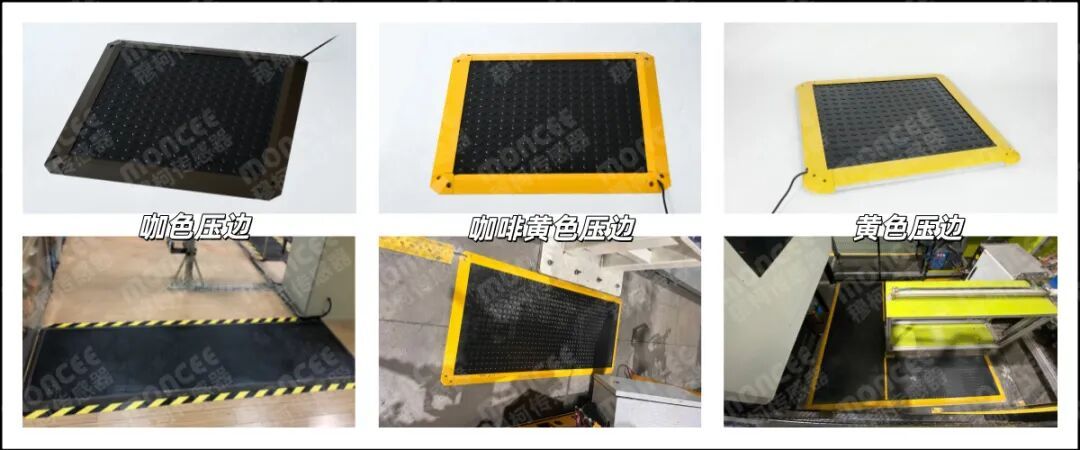
Depending on the application, different materials and constructions may be appropriate. The product range includes configurations using materials such as rubber-based materials and PUR, together with specialized versions for different industrial environments.
Standard or Customized Safety Pressure Mat?
For simple applications, a standard product can offer an efficient balance between cost and delivery time.
However, OEM projects often require something more specific.
Customization may involve:
Non-standard dimensions
Multiple-mat configurations
Cable outlet position
Material selection
Edge or frame configuration
Waterproof requirements
Special mechanical-load requirements
Controller integration
The SC4 range provides standard dimensions as well as customized configurations, while the installation documentation demonstrates how multiple mats can be assembled to protect a larger area.
For machine manufacturers, customization can be commercially valuable because the safety component can be adapted to the machine design instead of forcing the machine layout to accommodate an unsuitable standard size.
How to Source a Safety Pressure Mat for Industrial Projects
Choosing a supplier should involve more than requesting the lowest quotation.
1. Confirm the Technical Specification
Provide the supplier with the application, protected area, expected loads, working environment, required protection level, and control architecture.
This allows the manufacturer to recommend a suitable configuration rather than simply supplying the closest standard size.
2. Request Samples for Evaluation
For new applications, sample testing can help confirm mechanical suitability, installation requirements, triggering behavior, and compatibility with the intended safety control system.
3. Evaluate Customization Capability
If your company manufactures different machine models, ask whether the supplier can provide repeatable custom dimensions and configurations.
4. Consider Long-Term Supply
For OEM customers, supplier stability is critical. Consistent product specifications, quality control, production capacity, technical support, and delivery capability can have a greater impact on total procurement cost than the initial unit price.
5. Check Installation and Maintenance Support
A capable supplier should provide clear installation and maintenance information. The Moncee documentation includes installation procedures, multi-mat connection methods, functional testing, periodic maintenance, and replacement guidance.
Why Choose a Manufacturer Instead of Only Comparing Prices?
For industrial buyers, a Safety Pressure Mat is part of a machine safety solution. The supplier's technical capability can therefore directly affect project implementation.
A specialized manufacturer can potentially support the complete procurement process:
Application analysis → Product selection → Customization → Sample testing → Safety controller matching → Production → Installation support → Long-term supply
This is particularly valuable for OEMs that need the same safety mat configuration across multiple machine models or production batches.
Instead of treating every order as an individual transaction, buyers can establish standardized specifications with a manufacturer and create a more predictable procurement process.
Conclusion
A Safety Pressure Mat provides an effective approach to pressure-based area detection around industrial machinery when personnel access needs to be monitored.
However, the mat should not be evaluated solely according to its purchase price. Trigger force, response time, load capacity, material, environmental protection, dimensions, wiring, controller integration, and customization capability all influence whether a particular model is appropriate.
For OEM machine builders and automation integrators, the best sourcing strategy is to work with a manufacturer capable of providing both standard and customized Safety Pressure Mat solutions, supported by technical documentation, application assistance, and stable long-term supply.
Looking for a Safety Pressure Mat for automated machinery, robot areas, material handling equipment, or customized OEM applications? Moncee provides SC4 series safety mat solutions with different configurations and customization options. Contact us for technical consultation, sample evaluation, and a quotation tailored to your application.



 English
 简体中文
简体中文 Indonesian
 Previous:
 Back to list


