
As industrial automation moves toward faster production, flexible machine layouts, and closer human-machine interaction, manufacturers need safety devices that can protect moving equipment without unnecessarily restricting its operation. Safety-sensitive edge technology provides a practical solution for applications where crushing, shearing, or contact hazards exist along the moving edge of a machine, door, platform, or mobile device.
Unlike a rigid physical guard, a Safety Edge is a pressure-sensitive detection device. When an operator, product, or obstacle applies sufficient pressure to the sensing edge, the internal conductive elements change state and send a signal to the control system. The machine can then initiate a predefined stop or other safety response. The Moncee Safety Edge documentation describes this structure as a flexible sensing component consisting of an outer insulating layer, internal sensing elements, and an installation profile.
This makes safety-sensitive edge technology particularly suitable for automated equipment where hazardous movement itself creates the protection challenge.
How Safety-Sensitive Edge Technology Works
A typical Safety Edge is installed along the edge of a moving component. When the edge is compressed, the conductive layers inside the sensor come into contact and produce a change in electrical resistance or current. The connected controller detects the valid signal and can command the machine to stop or reverse its movement.
The Safety Edge therefore acts as the contact-detection layer, while the controller and machine safety circuit determine the resulting machine response. The Moncee documentation specifically describes Safety Edge and its controller as a flexible safety system for hazardous moving equipment.
This operating principle is valuable when a hazard may physically reach a person or object before conventional non-contact sensing can reliably identify the situation.
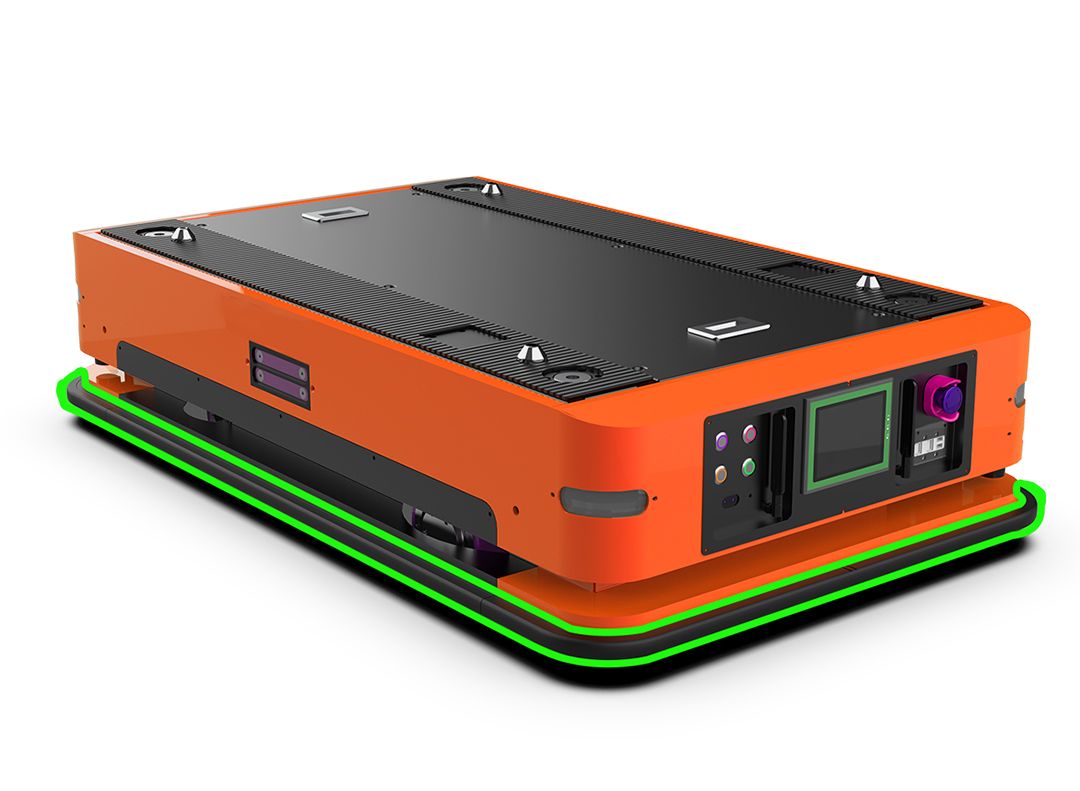
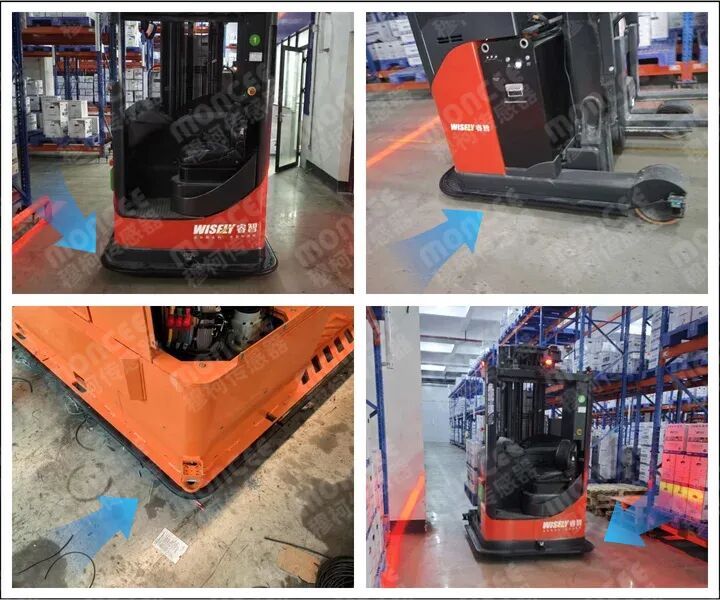
1. AGV and AMR Safety Protection
Automated Guided Vehicles (AGVs) and Autonomous Mobile Robots (AMRs) are among the most important applications for safety-sensitive edge technology.
Mobile robots operate in environments where people, materials, racks, machines, and other vehicles may share the same working space. Safety Edge technology can be installed around selected areas of the vehicle where direct contact with an obstacle could occur.
For example, a flexible safety edge can be mounted around the lower or front perimeter of an AGV. If an obstacle comes into direct contact with the sensing edge, the resulting signal can be incorporated into the robot's safety control system.
Industry solutions also combine safety edge switches with other safety technologies such as safety laser scanners and emergency-stop devices for AGV/AMR applications. (IDEC Corporate)
For OEMs developing mobile robots, this provides another sensing layer that can complement non-contact detection technologies.
2. Automated Doors and Industrial Doors
Automated doors are another established application for Safety Edge technology.
When an automatic door, sliding door, or powered gate closes, the moving edge itself can become a crushing or shearing hazard. A safety-sensitive edge can be installed along the closing edge so that physical contact is detected during movement.
When the sensing edge is compressed, the signal can be transmitted to the control system to initiate the configured safety response.
This application is particularly suitable for doors where the hazard moves toward the operator rather than the operator actively entering a fixed hazardous zone. Rockwell Automation's current safety-device selection documentation identifies pressure-sensitive safety edges as a solution for powered doors and other moving hazards. (Rockwell Automation)
For industrial door manufacturers, this means Safety Edge can be integrated directly into the mechanical design rather than added as a separate floor-level protection device.
3. Machine Tools and Automated Worktables
Automated worktables, machine-tool platforms, lifting mechanisms, and other moving machine components can create localized crushing and shearing points.
In these applications, a Safety Edge can be mounted along the exposed moving boundary. When an operator or foreign object enters the contact area, pressure on the edge generates the detection signal.
Moncee's product documentation identifies machine-tool worktables, automated equipment, material-handling machinery, and other moving mechanisms among the intended application areas.
This approach is particularly useful when the shape of the machine makes a conventional fixed guard difficult to install or when access to the moving component must remain flexible during production.
4. Lifting Platforms and Material-Handling Equipment
Lifting equipment creates another common automation safety challenge.
As a platform, lifting mechanism, or automated handling component moves vertically or horizontally, gaps can develop between the moving structure and surrounding equipment. These areas may present crushing or shearing hazards.
A safety-sensitive edge can be installed along selected contact boundaries to detect physical pressure. When integrated correctly with the machine's safety control circuit, the system can respond to contact before the hazardous movement continues.
For equipment manufacturers, the key is to select the Safety Edge according to the machine's movement speed, stopping distance, available installation space, and expected contact conditions rather than selecting a model based only on physical dimensions.
5. Tire and Rubber Machinery
Safety Edge technology is also suitable for industrial machinery used in tire and rubber production.
The Moncee documentation lists tire-forming machinery and rubber machinery among Safety Edge applications.
These machines may contain moving components with localized crushing or shearing hazards. A flexible sensing edge can follow the geometry of selected machine structures and provide contact detection around areas where personnel may interact with the equipment.
For OEM machine builders, flexibility is especially important because tire and rubber machinery can contain irregular structures and moving sections. Moncee provides multiple Safety Edge profiles, including different cross-sectional dimensions and triggering characteristics, allowing the sensor to be selected according to the installation requirements.
6. Packaging, Logistics, and Automated Production Equipment
Modern packaging and logistics systems often contain conveyors, transfer mechanisms, automated doors, positioning mechanisms, and other moving components.
Safety-sensitive edge technology can be used at selected contact points where direct physical interaction is possible. Instead of creating a large rigid barrier around every moving component, an appropriately designed Safety Edge can provide localized contact detection.
Moncee's application documentation includes packaging machinery, material handling, assembly machinery, stamping/press machinery, and automated equipment, demonstrating the broad applicability of the technology across industrial automation.
For system integrators, this makes Safety Edge a useful component when designing customized machine safety solutions.
Selecting the Right Safety Edge for Automation
Not every Safety Edge is suitable for every machine. Several technical parameters should be evaluated before purchasing.
Profile dimensions
The physical cross-section must fit the available installation space. Moncee provides multiple profiles, including 25 × 45 mm, 40 × 60 mm, 54 × 56 mm, and other configurations.
Trigger Distance and Trigger Force
These parameters determine how the sensor responds to mechanical contact. Moncee's catalog includes models with different trigger distances and forces, allowing selection according to the machine structure and application requirements.
Electrical configuration
The available configurations include Normally Open (NO) and Normally Closed (NC) signal modes, with different cable and lead-out arrangements.
Environmental requirements
Moncee's documented Safety Edge specifications include EPDM outer material, an operating temperature range of −30°C to +85°C, and IP65 protection. The catalog also specifies 12 V/24 V rated voltage options, a maximum working voltage of 36 V, and a maximum current of 30 mA.
These specifications should be matched to the actual machine environment rather than treated as universal requirements for every application.
Why Work with a Safety Edge Manufacturer?
For standard automation projects, an off-the-shelf safety edge may be sufficient. However, OEM machine builders often require customized lengths, profiles, cable configurations, or installation arrangements.
Moncee supports customized Safety Edge configurations, with documented options for product length, lead-wire configuration, and different installation arrangements. The catalog specifies a maximum single-piece length of 8 m and provides multiple wiring and lead-out configurations.
Working directly with a manufacturer can therefore simplify the process from technical selection and sample testing to customization and volume procurement.
For automation OEMs and system integrators, the objective should not simply be to purchase a safety-sensitive edge. The goal is to select a sensing component that fits the machine geometry, operating conditions, control architecture, and overall safety design.
Conclusion
From AGV and AMR systems to automated doors, machine tools, lifting equipment, tire machinery, packaging systems, and production-line automation, safety-sensitive edge technology provides localized contact detection for hazardous moving components.
Its flexible structure makes it suitable for applications where rigid guarding is impractical or where direct contact detection is required at the moving edge itself. However, the Safety Edge should be regarded as one component of the machine safety system; the actual protective response depends on the connected controller, safety circuit, machine stopping characteristics, installation, and overall risk assessment.
For manufacturers looking for a Safety Edge supplier, OEM Safety Edge solution, or customized safety-sensitive edge for automated equipment, Moncee can provide different profiles, triggering characteristics, electrical configurations, lengths, and lead-out options for application-specific selection.
Need a Safety Edge for your automation equipment? Contact Moncee for product selection, customization, and quotation based on your machine requirements.



 English
 简体中文
简体中文 Indonesian
 Previous:
 Back to list


