
There is a common understanding in the industrial sector: the biggest safety risks do not come from equipment failures, but from forcing standardized products onto non-standardized production environments.
Most safety mats currently available on the market are essentially mass-produced, template-based products.
They come with standardized dimensions, standardized base materials, limited specification options, and weak adaptability. Whether the application is a robotic welding station, tube bending machine, slitting machine, production line, or AGV transfer pathway, many manufacturers simply supply the same standardized products nationwide.
At first glance, these products appear convenient, affordable, and standardized. However, once installed on real production lines, various problems quickly emerge: irregular workstations may leave uncovered areas and safety blind spots; equipment with large dynamic operating ranges may not receive sufficient protection; under heavy loads, oil contamination, and frequent foot traffic, ordinary safety mats are prone to deformation, failure, and false triggering.
This is the typical problem of “copy-and-paste” industrial safety: the product is universal, but the working environment suffers.
Industrial sites are never identical. Equipment layouts, operating ranges, personnel movement paths, risk areas, and production processes all vary from one factory to another.
Using the same standardized safety mat to protect thousands of different industrial applications is, in itself, a potential safety hazard.
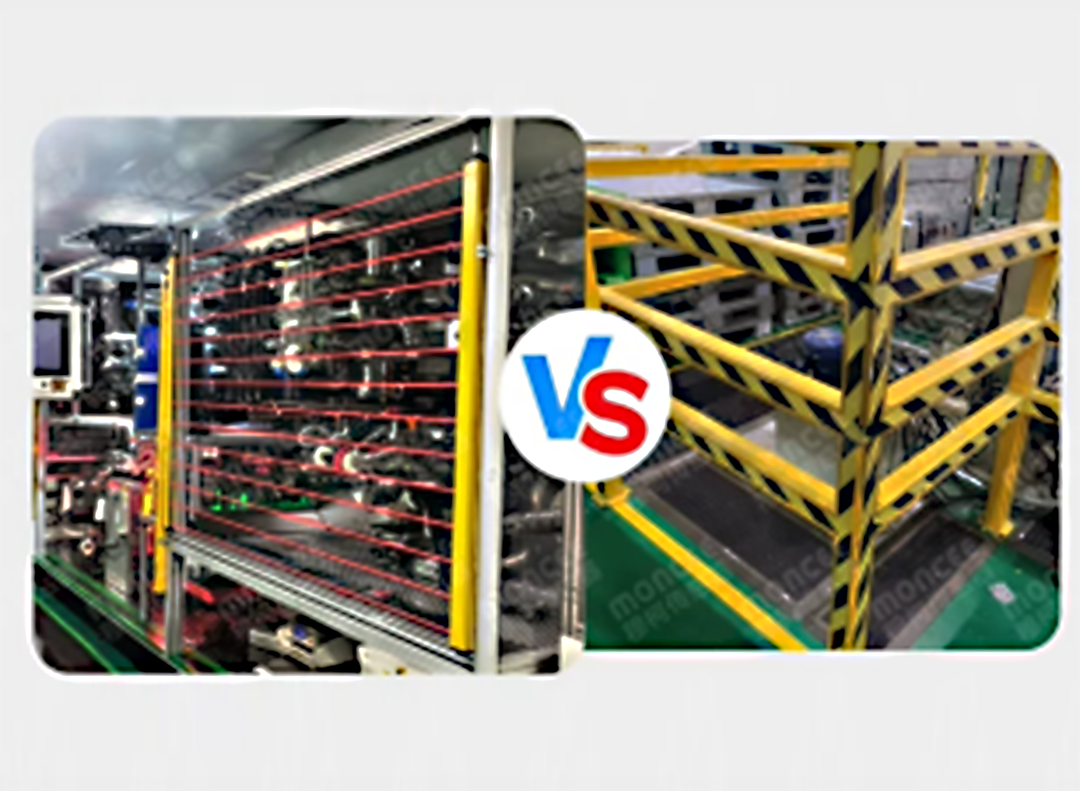
01 Why Are Standardized Safety Mats Becoming Less Suitable for Factories?
Many procurement managers and equipment supervisors share the same experience: low price is real, but poor usability is also real.
To achieve mass production and high-volume sales, many general-purpose safety mats on the market simplify their designs and rely on fixed shapes, without considering actual industrial working conditions.
1. Rigid Shapes Cannot Adapt to Non-Standard Workstations Such as Robots, Tube Bending Machines, and Injection Molding Machines
Most industrial danger zones around equipment are irregular, curved, or uniquely shaped.
Standard square safety mats often fail to provide complete coverage, leaving blind spots. Alternatively, after installation, they may interfere with equipment doors, tooling placement, or operator access, making the protection ineffective.
2. General Materials Cannot Withstand Industrial Wear and Tear
Machine oil, metal chips, heavy foot traffic, and extreme workshop temperatures can quickly damage ordinary safety mats.
Common low-grade models may become hardened, cracked, or lose sensing accuracy after short-term use, causing the safety barrier to fail.
For safety equipment, the greatest concern is not cost—it is unreliable performance.
A device that works sometimes and fails at critical moments is the biggest weakness of all standardized, copy-and-paste safety products.
02 Our Industrial Safety Mats: No Templates, Only Customized Solutions Based on Actual Working Conditions
We do not produce generic products or simply replicate standard models in bulk.
Our safety mats are industrial safety solutions designed specifically around each production line.
For machinery factories, automated production lines, robotic workstations, AGV pathways, and high-risk equipment areas, we provide solutions based on:
On-site customization
Working-condition optimization
Equipment-specific integration
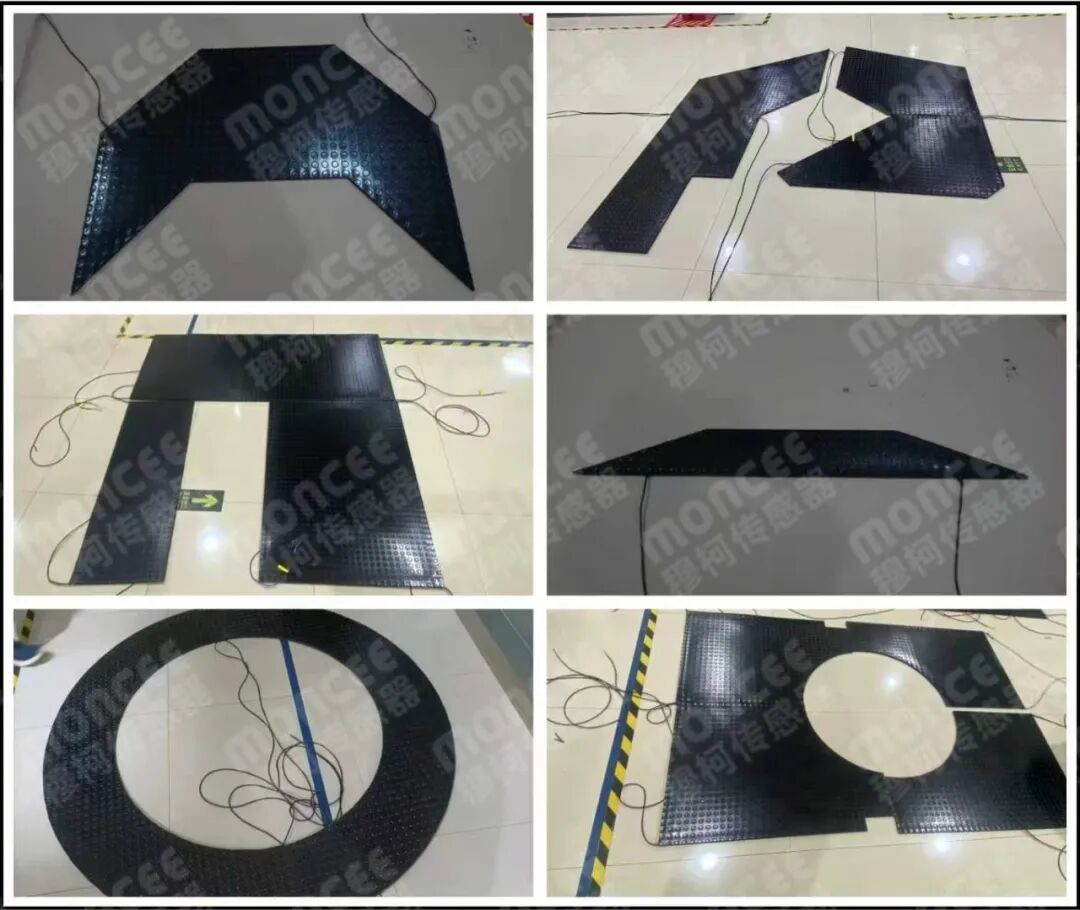
1. Customized Shapes and Dimensions for Complete Area Coverage
We are not limited to standard rectangular designs.
Our safety mats support:
Curved shapes
Cut-out sections
Customized contours
Multi-section assembly
Whatever the equipment shape and whatever the danger zone profile, we design the safety mat accordingly.
They precisely fit equipment bases, workstation corners, and operating edges, eliminating safety blind spots and adapting to non-standard industrial environments.
2. Industrial-Grade Materials Designed for Heavy-Duty Factory Conditions
To withstand oil contamination, metal debris, frequent stepping, and high/low temperature environments, we use reinforced industrial-grade materials with:
Enhanced wear resistance
High compression resistance
Corrosion resistance
Anti-aging performance
Excellent dimensional stability
Even under continuous 24-hour operation, the sensing performance remains stable, without drift, false triggering, or unexpected failure.
3. Strong Equipment Integration for a Complete Safety Control Loop
Our safety mats can connect with:
Robots
Punch presses
Press brakes
Hydraulic presses
PLC control systems
Warning lights
Emergency stop circuits
AGV scheduling systems
Once triggered by stepping, they can enable complete safety responses, including:
Warning signals
Speed reduction
Machine shutdown
Equipment locking
This is not simply a detection device placed on the floor—it is a true active safety solution capable of controlling machinery and protecting operators.
03 Industrial Safety Is Not About Standardization—It Is About Adaptation
Many manufacturers compete on price, sales volume, and technical specifications, but few compete on real-world application adaptability.
Selling one standard product everywhere may appear to increase safety equipment availability, but in reality, it can introduce hidden risks into countless factories.
Industrial safety mats are not decorative accessories, nor are they just tools for passing inspections.
They are the final physical safety barrier on a production line.
They do not require flashy concepts. They require:
Precise workstation compatibility
Stable and reliable performance
No false triggering
No missed protection areas
Long-term durability in harsh industrial environments
We always believe:
Reject one-size-fits-all copy-and-paste solutions. Provide industrial protection that truly matches each working condition.
Every safety mat leaving our factory represents a dedicated solution designed for a specific application.
Designed for the equipment.
Designed for the workstation.
Designed for the process.
Designed for production.
Making industrial safety no longer something that is compromised, overlooked, or left to chance.



 English
 简体中文
简体中文 Indonesian
 Previous:
 Back to list


